The Short Answer
Despite viral narratives of an “Airbnb collapse,” what we’re seeing is not a breakdown of the short term rental market, but a clear shift toward maturity. Airbnb has weathered regulatory crackdowns, increased competition, and post-pandemic growing pains. The platform’s removal of 100,000 low-quality listings and launch of premium services in 2025 signal a long-term commitment to quality over quantity. Demand remains strong, even as profitability for some hosts has declined. What this means for investors and property managers is simple: success now depends on strategic positioning, regulatory compliance, and creating standout guest experiences in a more competitive STR market.
Jump To
Detailed Timeline of the Airbnb Collapse
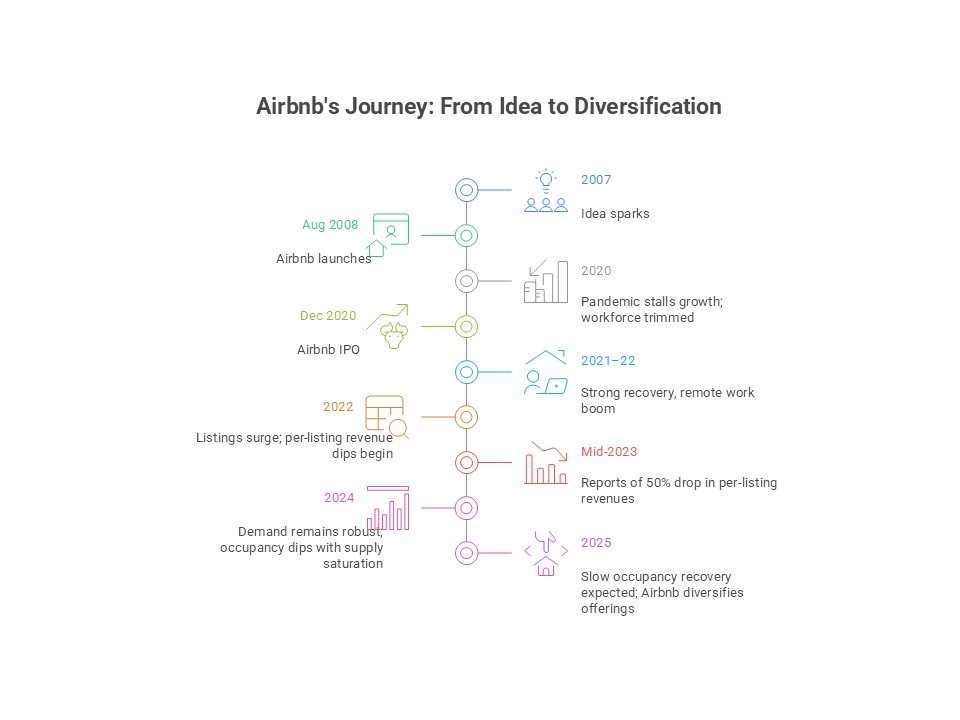
The story of Airbnb’s supposed collapse is more about market evolution than actual failure. Airbnb was founded in 2007 when Brian Chesky and Joe Gebbia rented air mattresses in their San Francisco apartment to conference-goers. By August 2008, the platform officially launched and began rapidly scaling. Over the next decade, it expanded globally, becoming a disruptor in the hospitality industry. However, the COVID-19 pandemic in early 2020 brought the short-term rental market to a halt. Bookings plummeted, Airbnb cut about a quarter of its workforce, and its future seemed uncertain. Surprisingly, the company rebounded quickly. By late 2020, it went public, raising $3.5 billion in its IPO, and capitalized on the remote work trend throughout 2021 and 2022.
In 2022, data began showing a decline in revenue per listing in major markets like Phoenix and Austin, prompting headlines about an “Airbnb collapse.” These claims gained traction in 2023 when viral posts suggested revenues had dropped nearly 50% in some cities. However, a deeper look shows that while revenue per active listing has decreased due to a significant increase in supply, Airbnb’s overall revenue has actually grown by over 70% in the past three years. For example, Phoenix saw its number of listings grow from 5,000 in 2017 to over 21,000 by 2025. This oversupply has led to softer occupancy rates and nightly prices, but it’s part of a natural market adjustment—not a collapse.
By 2024, while some hosts struggled with reduced margins, the overall short-term rental demand remained strong. Airbnb continued evolving by expanding its offerings and emphasizing quality. The narrative in 2025 points to a maturing market stabilizing after rapid expansion, rather than a crash. The Airbnb model remains resilient, driven by ongoing consumer demand and shifting travel habits.
What Sparked the Airbnb Collapse?
1. A Flooded Market
One of the biggest challenges currently facing the short term rental market is market saturation. As the Airbnb platform gained popularity, an influx of new property owners and investors rushed to list their homes and apartments. Cities like Dallas saw more than 6,000 new Airbnb listings added since 2020, far outpacing local demand. This oversupply has created intense competition among property managers, driving down nightly rates and occupancy in many areas. What once looked like easy profit has become a struggle for visibility and pricing power in an increasingly crowded STR market.
2. Tightening Legal Restrictions
Many city governments are now enforcing stricter rules on the short term rental market in response to concerns about local housing markets and community disruption. In places like San Francisco and New York, new regulations are forcing Airbnb owners to rethink their strategies—or leave the market entirely. New York’s Local Law 18, implemented in 2024, requires hosts to register with the city and prove they live in the unit being rented. This added red tape undermines the flexibility that once defined Airbnb and has become a major barrier for everyday property managers. As regulation increases, Airbnb inventory declines, and fewer hosts are able to operate profitably within the law.
3. Economic Pressures and Changing Traveler Habits
Macroeconomic factors have added more headwinds to the already tense short term rental market. High inflation has increased operating expenses across the board, from maintenance to utilities to professional cleaning. Rising interest rates have also made it more expensive for property owners to finance new purchases or refinance existing mortgages. On the guest side, tighter budgets and fears of a looming recession have led to shorter trips and more conservative spending. This double hit—higher costs and lower demand—has left many STR operators struggling to keep margins healthy.
4. Rising Competition from Hotels and Other Platforms
What was once Airbnb’s clear playing field is now shared with a growing number of platforms and resurgent hotel brands. Companies like Vrbo, Booking.com, and Hopper have diversified the STR market by targeting niche audiences such as luxury or eco-conscious travelers. At the same time, hotel chains have rolled out extended-stay and apartment-style rooms to compete directly with Airbnb listings. These new options offer the reliability and customer service hotels are known for, which is appealing in today’s uncertain travel climate. With many local housing markets tightening their restrictions on short-term rentals, hotels have also found an opening to win back guests.
5. The Shrinking Advantage of Short-Term Rentals
In the early days of Airbnb, the financial upside of hosting was obvious: nightly rates for short stays often outperformed monthly rental income. But that edge has eroded as market saturation has grown and housing shortages have pushed up long-term rental prices. Today, in many cities, the gap between short-term and long-term income has narrowed to the point where it no longer justifies the effort, risks, and volatility of the short-term model. For many hosts, the stability of traditional leasing now outweighs the challenges of managing a property on the Airbnb platform.

Why Did Airbnb Remove 100,000 Listings?
In March 2024, Airbnb took a major step to improve guest trust by removing over 100,000 Airbnb listings from its platform. This decision, one of the most sweeping enforcement actions in the company’s history, was part of a broader push to raise quality standards and eliminate underperforming or non-compliant properties from the short term rental market. The listings were removed based on a new host performance system that evaluates metrics like guest ratings, cancellation rates, listing accuracy, and host responsiveness.
The company’s rationale was clear: many of these listings consistently failed to meet expectations, leading to negative reviews, broken promises, and a weakened reputation across key local housing markets. Airbnb emphasized that the move was not just about removing properties, but about reinforcing its long-term commitment to delivering safe, reliable, and well-managed stays. For guests, that means fewer surprises. For property managers, it signals that Airbnb is raising the bar on quality and accountability within the STR market.
This mass delisting effort came on the heels of Airbnb’s rollout of a new hosting quality system launched in April 2023. Designed to enforce a more standardized guest experience, the system uses data to flag hosts who consistently underdeliver. Rather than focusing solely on volume, Airbnb is pivoting toward a model that prioritizes consistency, cleanliness, and legal compliance. The company has stated that these properties will not be relisted unless they meet new quality benchmarks.
To further reinforce trust, Airbnb introduced a listing verification initiative starting in September 2024. This program includes visual proof requirements—such as video and photo verification—and awards verified badges to listings in the U.S., Canada, Australia, France, and the U.K. The program is expected to expand to 30 additional countries later this year. This added layer of transparency is intended to give both travelers and property owners more confidence in the platform’s offerings and help restore Airbnb’s reputation in a highly competitive short term rental market.
Ultimately, this move signals Airbnb’s pivot away from growth at any cost and toward a more curated, guest-first experience. It’s a strategic step to regain the trust of users while ensuring the Airbnb platform continues to set a high standard in an increasingly regulated and crowded space.

Is Airbnb Recovering In 2025?
After a turbulent few years, signs point to a steady recovery for the short term rental market in 2025. While occupancy rates dipped between early 2022 and spring 2024, they’ve since stabilized. More importantly, guest demand has returned to healthy levels—nights booked rose 7% in 2024 compared to the previous year. This demand resilience, combined with a slowdown in new Airbnb listings, is giving both seasoned hosts and newer property managers a chance to breathe.
One reason for the improved outlook is the tapering of market saturation. The post-pandemic surge in STR market participants—many of whom were drawn in by the promise of passive income—has cooled. As new supply levels off, Airbnb hosts are finding it easier to attract bookings without slashing prices. This equilibrium between supply and demand has allowed the local housing markets in high-demand areas to start recalibrating, while Airbnb continues evolving its platform to stay competitive.
In 2025, Airbnb has doubled down on improving the guest experience, launching a new suite of on-demand services called Airbnb Services. These offerings span everything from in-home personal chefs and certified massage therapists to professional stylists and fitness experts. The company has introduced 10 service categories across 260 cities, with expansion plans underway. It’s a strategic pivot aimed at elevating short-term stays to luxury-level experiences while giving hosts new tools to differentiate their listings.
Additionally, Airbnb has reimagined its Airbnb Experiences program. Now available in over 650 cities, these curated experiences—ranging from cultural tours and cooking classes to outdoor adventures and personal styling—are hosted by locals and designed to deepen a traveler’s connection with the destination. This innovation allows Airbnb owners and property managers to offer more than just a place to sleep—it’s about crafting a complete stay.
With these strategic rollouts and a more balanced inventory pipeline, Airbnb is actively shaping a future that focuses on quality, community, and sustainability in the short term rental market. For both travelers and hosts, 2025 is looking less like a recovery and more like the beginning of a smarter, more service-driven Airbnb ecosystem.

How Is The Short-Term Rental Market Evolving In Response To Airbnb's Decline?
While some headlines suggest Airbnb is in decline, the reality is more nuanced—and the broader short term rental market is evolving accordingly. Airbnb’s continued innovation, including its expansion into high-touch guest services and curated experiences, reveals that consumer demand for alternative accommodations remains strong. At the same time, this evolution is pushing both hosts and property managers to reassess their roles in a maturing industry.
Airbnb’s strategic shift toward full-service travel—through offerings like Airbnb Services and reimagined Experiences—signals a move beyond simple lodging. These additions challenge traditional travel agencies and online booking platforms by turning the Airbnb platform into a one-stop destination for personalized travel planning. As Airbnb deepens its hospitality offering, it raises the bar for what guests expect from short-term stays, especially in competitive local housing markets.
However, this progress is not without growing pains. Many investors who entered the STR market during its peak—drawn by the allure of high returns—are now facing tighter margins. As market saturation and regulatory pressure reduce profitability, some of these property owners are beginning to exit the space. The result? A gradual release of short-term rental properties back into the long-term rental pool, helping to ease housing shortages in popular tourist cities and stabilizing home prices.
This shift is already having ripple effects in the broader real estate landscape. Cities with previously inflated STR concentrations are seeing a boost in long-term rental availability as units transition back to traditional leasing. For tenants, this could mean more options and slightly improved affordability. For property managers, it creates new opportunities to serve landlords seeking more predictable, less volatile returns.
Ultimately, the short term rental market is moving toward a more professional, guest-centric model—one where quality, compliance, and added value matter more than simple listing volume. Airbnb’s repositioning is both a reaction to and a driver of this transformation, and the platforms and operators that adapt quickly will be best positioned to thrive in the next phase of short-term hospitality.

Final Thoughts - Should You Still Invest In Short Term Rentals?
The short answer is yes — but with caveats. The golden days of easy profits and minimal oversight in the short term rental market are gone. Today’s successful Airbnb hosts are adapting to a new landscape defined by guest expectations, legal scrutiny, and elevated service standards. For prospective investors, this means doing your homework: understand local housing markets, evaluate regulatory risks, and consider whether your property can truly stand out. Platforms like Airbnb are evolving rapidly, and those who treat their rentals like professional hospitality businesses—not just side hustles—are the ones most likely to thrive in 2025 and beyond.