The Short Answer
Being a realtor can be financially rewarding, but income varies greatly depending on several factors. Most real estate agents earn commissions rather than salaries, and the average annual income sits around $47,000, with potential to exceed $100,000 for experienced agents in strong markets. Those working in high-demand areas, specializing in lucrative niches like luxury or investment real estate, or operating at a high volume tend to earn more. However, newer agents or those in slower regions may make under $10,000 in their early years.
Key factors like real estate market conditions, brokerage commission splits, marketing efforts, and time commitment all play a role in determining income. Real estate agents who are strategic, committed, and supported by strong brokerage partnerships often see the best results. While it’s not a guaranteed high-income path, for those willing to put in the work, real estate can offer both flexibility and strong earning potential.
Skip To
Do Realtors Make Good Money?
Rather than receiving a fixed salary, most real estate agents earn a commission based on the sale price of a property. This means their income can vary widely depending on experience, location, and market conditions. As of March 1, 2025, the average annual income for a Real Estate Sales Agent in the U.S. is $47,174, according to the National Association of realtors (NAR).
However, earnings can range significantly. Data from Salary.com reports that most real estate agents earn between $46,085 and $60,005, with overall salaries ranging from $45,093 to $71,686. Experience plays a major role in income potential—NAR data reveals that real estate agents with 16 or more years in the business can earn over $100,000 annually, while those with two years or less typically make under $10,000.

What Factors Determine How Much Money A Realtor Makes?
A realtor’s income isn’t one-size-fits-all, it’s shaped by a range of factors that influence how much they can earn in any given year. Here’s a breakdown of the key variables:
Factor 1: Local real estate market
The strength of the local real estate market plays a huge role in a realtor’s earning potential. In high-demand areas with rising home prices and steady transaction activity, agents are more likely to close deals and earn higher commissions.
Factor 2: Brokerage fees
Every realtor works under a brokerage, which typically takes a cut of their commission. Some brokerages charge higher fees in exchange for support and lead generation, while others offer more favorable splits but fewer resources. The structure of this agreement can significantly impact take-home pay.
Factor 3: Agent experience and specialty
Experience often correlates with higher earnings. Seasoned agents tend to have larger networks, better negotiation skills, and a strong client base. Additionally, realtors who specialize in high-end properties, commercial real estate, or investment properties can command larger commissions.
Factor 4: Sales volume and transaction price
The number of homes an agent sells and the average price of those homes directly affect income. A high volume of lower-priced properties might yield similar earnings to a smaller number of luxury transactions—depending on commission rates.
Factor 5: Marketing and networking
An agent’s ability to generate leads through marketing and networking is crucial. Effective use of social media, online advertising, open houses, and community involvement can drive more listings and buyer interest, which ultimately means more sales and more income.
Factor 6: Time commitment
Real estate is often a full-time (and then some) career. Agents who commit more hours to their business—responding to clients, hosting showings, and staying up to date on market trends—tend to close more deals and earn more as a result.

Why Do Some realtors Earn More Than Others?
While all real estate agents work on commission, their actual earnings can vary widely—and that’s no accident. A combination of strategy, location, support systems, and experience helps explain why some agents outperform others financially.
Realtors working in high-priced markets like New York City or Los Angeles often have the opportunity to earn more, simply because property values (and therefore commissions) are higher. In contrast, agents in smaller or rural markets may need to close more deals to reach similar income levels.
Brokerage support also plays a crucial role. Agents with more favorable commission splits or robust lead-generation tools can retain more of their earnings and close deals more efficiently. Similarly, those who invest time in building their business—through marketing, networking, and client service—tend to generate more referrals and repeat business.
Specialization can further boost income. Real estate agents who focus on luxury homes, commercial real estate, or real estate investing typically earn more due to higher transaction values and niche expertise. Others expand their services by working closely with property managers or even taking on property management roles themselves, creating an additional income stream and ongoing client relationships.
Ultimately, the real estate agents who earn the most are those who combine market opportunity with time, dedication, and strategic business development. They treat real estate not just as a job, but as a long-term career worth investing in.
Average Realtor Salary In Each State
| State | Average Salary |
|---|---|
| Alabama | $78,082.32 |
| Alaska | $78,578.84 |
| Arizona | $83,216.92 |
| Arkansas | $73,496.68 |
| California | $95,253.16 |
| Colorado | $86,065.28 |
| Connecticut | $80,283.44 |
| Delaware | $89,356.88 |
| Florida | $71,147.96 |
| Georgia | $79,109.44 |
| Hawaii | $85,251.88 |
| Idaho | $75,237.92 |
| Illinois | $72,168.60 |
| Indiana | $77,794.08 |
| Iowa | $71,237.68 |
| Kansas | $76,068.08 |
| Kentucky | $73,016.44 |
| Louisiana | $72,882.80 |
| Maine | $80,449.92 |
| Maryland | $88,547.92 |
| Massachusetts | $83,604.52 |
| Michigan | $78,804.28 |
| Minnesota | $79,735.76 |
| Mississippi | $80,474.68 |
| Missouri | $68,228.56 |
| Montana | $84,843.92 |
| Nebraska | $91,926.05 |
| Nevada | $87,411.15 |
| New Hampshire | $80,134.88 |
| New Jersey | $88,168.45 |
| New Mexico | $82,080.10 |
| New York | $96,842.80 |
| North Carolina | $84,134.65 |
| North Dakota | $82,796.44 |
| Ohio | $78,378.05 |
| Oklahoma | $67,193.00 |
| Oregon | $85,573.25 |
| Pennsylvania | $80,290.25 |
| Rhode Island | $78,489.60 |
| South Carolina | $81,080.95 |
| South Dakota | $79,711.88 |
| Tennessee | $77,953.10 |
| Texas | $75,714.40 |
| Utah | $77,316.20 |
| Vermont | $85,900.76 |
| Virginia | $86,071.60 |
| Washington | $92,224.76 |
| West Virginia | $70,462.60 |
| Wisconsin | $80,977.55 |
| Wyoming | $71,583.48 |
Source: Luxury Presence
How Do Commission Splits Work?
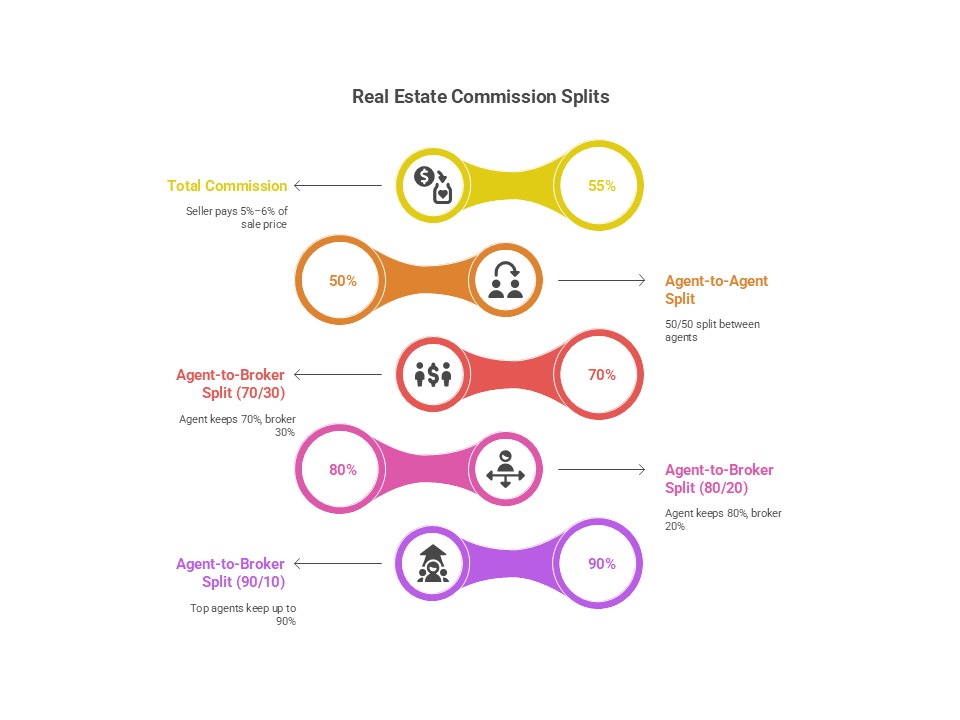
In real estate, commission earnings don’t go straight into an agent’s pocket. Instead, commissions are typically split multiple ways—first between the listing and buyer’s agents, and then again between each agent and their respective brokerages. Understanding these splits is key to knowing how much a realtor actually takes home from a transaction.
Step 1: Splitting Between Agents
The total commission is typically agreed upon in the listing agreement and usually ranges from 5% to 6% of the property’s sale price (though this can vary by region, property type, or market conditions). For rental properties, the commission is often equivalent to one month’s rent.
Example:
Let’s say a home sells for $600,000, and the agreed commission is 5%.
- Total Commission = $600,000 × 5% = $30,000
- If the selling agent and buyer’s agent split this evenly, each gets $15,000.
Step 2: Splitting With Brokerages
From there, each agent (buyer agent and selling agent) shares their commission with their brokerage. This split depends on the agent’s experience, performance, and the agreement they have in place.
Example:
If the buyer’s agent has an 80/20 split with their brokerage:
- Agent keeps 80% of $15,000 = $12,000
- Brokerage keeps 20% of $15,000 = $3,000

Common Commission Split Models in Real Estate
Not all real estate agents get paid the same way—even if the total commission on a deal is the same. The commission split model between an agent and their brokerage plays a big role in determining take-home pay. Here are the most widely used structures in the industry, each with its own benefits and trade-offs:
1. Traditional Flat Split
This is a fixed percentage arrangement that doesn’t change regardless of how much an agent sells. For example, a 60/40 split means the agent keeps 60% of each commission, and the brokerage retains 40%. It’s simple and predictable but can be limiting for top producers who generate higher revenues.
2. Performance-Based Tiered Split
Also known as a graduated or sliding scale model, this setup rewards productivity. Agents start at a lower split (like 50/50), but as they hit sales milestones, the brokerage reduces its share. After reaching a set revenue goal, an agent might earn 80% or more of commissions—encouraging growth and hustle.
3. Commission Cap Model
This structure offers a financial ceiling to what the agent pays the brokerage annually. Once the cap is met—say $25,000 in brokerage fees—the agent retains 100% of commissions for the remainder of the year. It’s especially popular with high-volume agents who want to maximize income after hitting that threshold.
4. 100% Commission with Flat Fees
In this independent model, the agent keeps the full commission but pays the brokerage a flat fee per transaction or a monthly desk fee. It gives agents full control over their earnings, but also places the burden of marketing, lead generation, and administrative costs squarely on their shoulders.
5. Team-Based Commission Sharing
Within real estate teams, commission distribution depends on role and responsibility. A lead agent may take a large portion (e.g., 50%), while buyer agents, showing assistants, and support staff split the rest based on pre-agreed terms. This setup supports scalability but can dilute individual earnings.
Is Being a Realtor Worth It In 2026?
For many, becoming a licensed real estate agent in 2026 can be a rewarding career choice—but it depends on your goals, location, and willingness to hustle. The job offers flexibility, the potential for high earnings, and the satisfaction of helping clients make major life decisions. However, it’s also competitive, requires self-motivation, and success isn’t guaranteed.
With the housing market adapting to changing interest rates and buyer behavior, real estate agents who invest in marketing, specialize in high-demand niches such as real estate investing, and leverage technology can still build a profitable business. New agents should be prepared for a slow ramp-up, but over time, with consistent effort, the income potential and career growth can be significant.
FAQ
Most realtors are independent contractors, not salaried employees. That means they typically earn income solely from commissions based on completed sales or leases. Some agents working with large teams or brokerages may receive a small base or stipend, but the bulk of their earnings come from closed deals.
While commission checks can look large, they’re often split between multiple parties -agents, brokers, teams – and cover all the agent’s expenses, from marketing to insurance. realtors also invest significant time and effort into each transaction, often working evenings and weekends with no guarantee of payment unless a sale closes. When viewed in context, most agents earn their commissions through hard work and dedication.