
Real estate investing runs on data. The faster you can identify a motivated seller, understand a neighborhood’s risk profile, and build a targeted outreach list, the better your deal flow. PropertyRadar has built its platform around exactly that premise, pulling from public records to give investors, agents, and mortgage professionals a searchable window into property and owner data across the entire United States.
This review covers what PropertyRadar actually does, how its features hold up in practice, what it costs, and how it compares to alternatives in 2026, so you can decide whether it belongs in your toolkit.
Table of Contents
What is PropertyRadar?
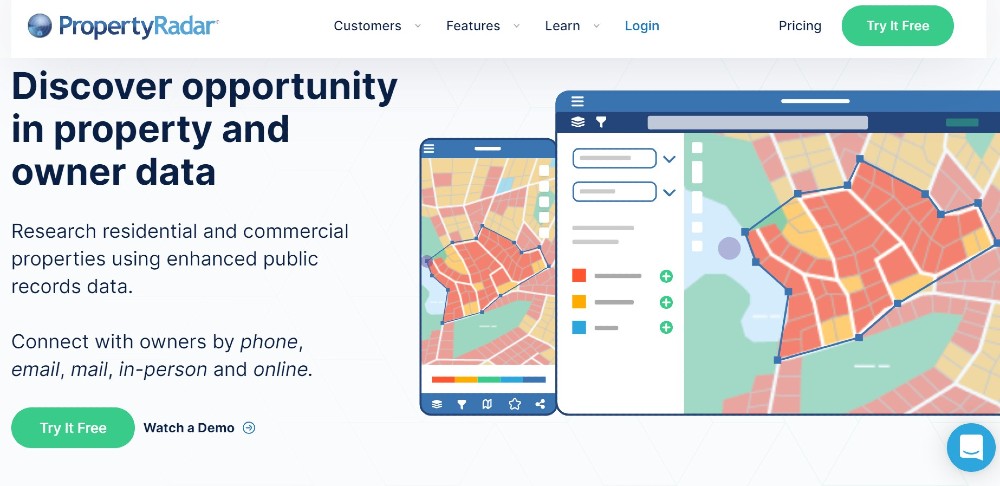
PropertyRadar is a data platform for real estate professionals. Its core function is simple: search any property or owner, get comprehensive data, build a list, and then market to that list. The platform pulls from county public records and synthesizes ownership history, equity estimates, mortgage details, foreclosure status, demographic data, and community risk factors into a single interface.
It is designed for a broad audience – residential investors, commercial real estate professionals, mortgage brokers, and agents. However, its deepest value is for investors who need to find off-market opportunities and connect directly with owners.
How PropertyRadar works
When you log in, you have two core search modes: search by property or search by person. The property search lets you enter an address, APN (Assessor Parcel Number), or use a GPS-based “nearby” function to see what is around you. The owner search lets you look up a person or company by name, mailing address, email, or phone number, and then see every property they own, anywhere in the country.
From there, the workflow moves through three stages: find, list, and market.
You find properties using the heatmap or the drive-through mobile feature. You build lists using PropertyRadar’s filtering tools. And you reach out via direct mail, phone, or integrated CRM campaigns.
Below is a breakdown of how each core feature works in practice.
PropertyRadar Features
Person vs. location search
Most property data platforms are location-first. PropertyRadar adds an owner-first layer that most competitors do not offer. Search a name and pull every property a person or company owns nationwide in a single query. Each result surfaces a full ownership summary: contact details, estimated equity, sale history, current loan information, and any foreclosure activity — all without leaving the platform.
Heatmap and drive-through feature
The heatmap is PropertyRadar's visual discovery layer. After selecting a location, the map populates with properties color-coded by your chosen filter criteria — estimated equity, owner age, vacancy status, estimated value, and more than 200 other data points. Clicking any property gives you a quick-view card with ownership details, estimated value, equity, and listing status. The drive-through feature extends this to the field: using the mobile app, the GPS-enabled map updates in real time as you drive, flagging relevant properties around you based on your active filters.
Property and owner data
For each property, PropertyRadar surfaces location and parcel details, estimated value and equity, ownership history, mortgage and loan details, foreclosure and pre-foreclosure status, tax delinquency information, vacancy status, investment data for fix-and-flip or rental analysis, and comparable sales in the area. Owner profiles include mailing address, phone numbers, email addresses, social media links, and a complete list of all other properties they own — the contact depth that makes direct outreach practical.
Community demographics and risk data
Beyond individual properties, PropertyRadar pulls in neighborhood-level context: demographic profiles covering average income, age distribution and household composition, environmental risk factors, housing statistics, and indicators like foreclosure density. The platform also flags property-specific risks including land use restrictions, flood zones, and title issues. For investors comparing two markets, this data can sharpen the decision significantly, a neighborhood with strong demographic tailwinds carries a materially different risk profile from one with concentrated foreclosure activity.
List building and Quick Lists
Once you have a target market and active filters, PropertyRadar saves those results as a dynamic list. Lists can contain hundreds or thousands of properties and can be segmented further — absentee owners with high equity in pre-foreclosure, or cash buyers who have purchased in the last 12 months, for example. Quick Lists are pre-built filters for common investor use cases: foreclosures, cash buyers, high-equity owners, and more. Lists update automatically as new data is recorded, and automated alerts trigger when a property's status changes.
Marketing and outreach
PropertyRadar integrates with direct mail services and exports to more than 2,000 applications via Zapier. You can send physical mail through a print partner, export contact data for email or phone campaigns, and connect lists to CRM platforms. Automation keeps campaigns active as new properties enter a list — so any new qualifying property in your target filter automatically enters your campaign queue without manual intervention.
Mobile app
The PropertyRadar mobile app is available on iOS and Android and is free to download for subscribers. Its primary use case is field work: GPS-enabled mapping lets you pull up live property and owner data while on site, and the drive-through feature makes it practical for neighbourhood canvassing. The app displays ownership type, estimated equity, sale status, vacancy, foreclosure status, and estimated value for any nearby property.
PropertyRadar Pros and Cons
The infographic below summarizes the key strengths and limitations.
PropertyRadar Pricing
PropertyRadar offers two main subscription tiers and a custom enterprise option. All plans include a 3-day free trial, and you can cancel at any time without penalty.
| Plan | Monthly price | Annual saving | Key inclusions |
|---|---|---|---|
| Essential | $49 / mo | $120 on annual plan | Property and owner search, list building, heatmap — Standard data tier. No team seats or integrations. |
| Complete | $79 / mo | $240 on annual plan | All Essential features at Premium data depth, plus integrations and team access. |
| Custom | Contact for quote | Varies | All platform features at Premium level. Enterprise volume and custom data configurations. |
The Essential plan suits investors who are just getting started with list-based prospecting and want to test the platform’s core data before committing to a higher tier. The Complete plan is the more practical option for active investors who rely on integrations with CRM tools or run multi-person operations. Both plans allow you to cancel and switch at any point, so there is no long-term contract risk.
If you are evaluating the platform as part of a broader lending or deal analysis process, our DSCR loan calculator and fix and flip loan tools can complement the data PropertyRadar surfaces with actual financing numbers.
A Typical PropertyRadar Workflow
To make the feature set more concrete, here is how an investor might use the platform from start to finish:
1. Identify a target market. Open the heatmap, navigate to a target city or ZIP code, and apply filters — for example, absentee owners with estimated equity above 40% and no active mortgage delinquency.
2. Canvass in the field. Use the mobile app’s drive-through mode to physically tour the neighbourhood, with the live map flagging relevant properties as you pass them.
3. Build a list. Save filtered results into a named list. Apply Quick Lists for additional pre-built criteria such as foreclosure status or cash buyer history.
4. Research owners. Click through to individual owner profiles to review contact information, property history, and any other assets they hold.
5.Launch an outreach campaign. Export the list to your CRM via Zapier, or use PropertyRadar’s direct mail partner to send physical postcards to the list. Set up automated alerts so new properties that match your criteria enter the campaign automatically.
6. Monitor and follow up. Track status changes — a property entering pre-foreclosure, a new listing going live, and trigger follow-up actions via automation.
This workflow is where PropertyRadar earns its subscription fee. The data quality is strong and the list-building logic is flexible enough for most investor use cases. The learning curve is real but manageable once you work through the tutorial videos.
How PropertyRadar's Data Supports Better Investment Decisions
One aspect of PropertyRadar that is easy to overlook is the risk and demographic layer. For investors comparing two markets or evaluating whether a specific asset is worth pursuing, the platform surfaces information that would otherwise require manual research across multiple public databases.
Demographic data — average household income, age distribution, household size — helps investors assess the likely rental demand profile for a property. A neighbourhood with a high concentration of young professional households has a different rental strategy than one with older long-term owner-occupiers.
The risk data — foreclosure density, vacancy rates, tax delinquency clusters — flags areas where broader market stress might affect exit values. This context matters especially for fix and flip investors who need to be confident about ARV in markets where comparable sales could be distorted by distressed activity.
According to the National Association of Realtors, data-driven market analysis has become a standard part of professional investment underwriting, and platforms like PropertyRadar have helped make that process accessible to smaller operators who previously had to rely on county records searches done manually.
PropertyRadar Competitors
PropertyRadar vs PropStream
PropStream is the most direct competitor. Like PropertyRadar, it aggregates MLS and county data, offers owner search, heatmapping, and marketing list exports. The key differences: PropStream is priced at $99 per month, making it roughly 25–100% more expensive depending on which PropertyRadar plan you are comparing against. PropStream offers a 7-day trial to PropertyRadar’s 3 days. PropStream is more explicitly aimed at agents and brokers, while PropertyRadar’s toolset is broader.
For investors prioritising cost and list-building flexibility, PropertyRadar edges ahead. For brokers who want deeper MLS integration alongside off-market data, PropStream may fit better.
PropertyRadar vs. BatchLeads
BatchLeads focuses heavily on skip tracing and direct marketing. It is strong for investors who prioritise contact data and outbound volume over property analytics depth. It tends to be cheaper at entry level but narrows faster for users who want the heatmap and community data layers that PropertyRadar provides.
PropertyRadar vs. FlipScout
FlipScout by New Silver takes a different angle entirely. It is a free tool designed to help investors identify fix-and-flip opportunities by ZIP code, showing estimated repair values, return on investment projections, and potential rehab costs for listed properties. It does not offer the owner search or direct mail integration of PropertyRadar, but for investors purely focused on identifying deal opportunities rather than building off-market outreach lists, it is a capable and cost-free starting point.
| Platform | Starting price | Free trial | Best for | Standout feature |
|---|---|---|---|---|
| PropertyRadar | $49/mo | 3 days | Investors, agents, mortgage pros | Owner-first search + drive-through mobile |
| PropStream | $99/mo | 7 days | Agents and brokers | Deep MLS integration alongside off-market data |
| BatchLeads | ~$34/mo | Yes (limited) | High-volume outreach campaigns | Skip tracing and bulk contact export |
| FlipScout (New Silver) | Free | No trial needed | Fix-and-flip investors | ROI, ARV and rehab cost estimates on listed properties |
How To Download The PropertyRadar App
The PropertyRadar mobile app is available on the Apple App Store and Google Play Store. Search for “PropertyRadar” and download for free. A paid subscription is required to access the data features, the app uses your account login to surface the same property and owner information available on the desktop platform.
Is PropertyRadar Worth It?
For investors who rely on off-market deal flow, PropertyRadar is a genuinely useful tool. The owner-first search, the 200+ filter criteria for list building, and the live drive-through mobile feature are capabilities that few platforms at this price point offer. The data accuracy is strong because it sources directly from public records, and the automation features reduce the manual overhead of running ongoing prospecting campaigns.
The $49 per month Essential plan is accessible for newer investors, though active users will likely want the Complete plan at $79 for the integrations and deeper data. The 3-day trial is enough time to stress-test the list-building and heatmap features against a target market.
The platform is not the right fit for investors primarily focused on rental analytics — cash-on-cash return modeling, cap rate analysis, and rental yield projections are not what PropertyRadar is built for. For that layer of analysis, tools like our rental property calculator or dedicated rental platforms handle the numbers better.
If your prospecting strategy involves direct outreach to owners, targeted list campaigns, or field canvassing, PropertyRadar is worth the trial. It is particularly well-suited to fix-and-flip investors, wholesalers, and mortgage professionals who need to source leads proactively rather than waiting for listings to appear on the MLS.